The rights of same-sex couples in Monaco
Publié par Paolo Petrini le 27/11/2025
Temps de lecture
17
min.
Taxation and Legislation
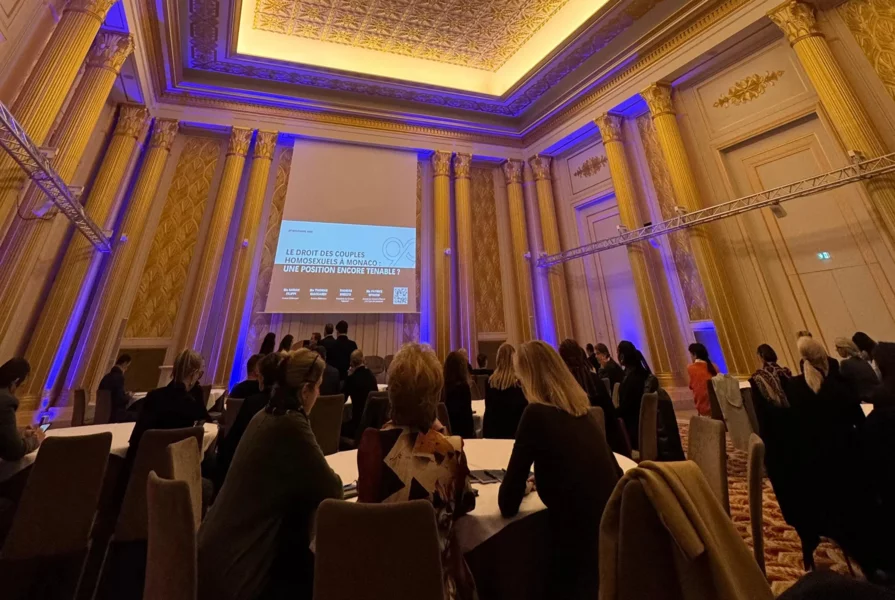
On 27 November 2025 the law firm 99 Avocats gathered four key figures of the legal sphere in Monaco for a densely packed conference devoted to an increasingly unavoidable subject: the legal status of same-sex couples in the Principality. Around the table, advocates Sarah Filippi and Thomas Giaccardi, National Council president Thomas Brezzo and Patrice Spinosi—lawyer at the Conseil d’État and the Court of Cassation—offered a rigorous assessment of Monaco’s realities. As Ms Filippi reminded at the outset, “this is not a matter of opinion but an objective reading of the law and its effects.” These legal issues are particularly relevant for many prospective residents considering settling in Monaco, sometimes as a couple.
Discover our selection of apartments
for sale in Monaco
for sale in Monaco
Studios, one- to five-bedroom apartments, penthouses and prestigious properties
Before an attentive audience under the gilded ceilings of the conference rooms at Monte Carlo One in the Carré d’Or district, the panellists presented a comprehensive overview of the legal obstacles, structural inconsistencies and human and financial consequences that still affect same-sex couples living in Monaco. Far from a theoretical debate, the conference highlighted concrete situations with deep implications: succession, parentage, recognition of the couple, public order, transcription of foreign marriages, inheritance tax, adoption, and how the cohabitation contract works.
Through these analyses, one conclusion emerges: the Principality is at a turning point, fragile in its current stance and under pressure from European standards that are evolving rapidly. This factual analysis shows a country facing rising social expectations and an ever more exacting continental dynamic, while its family law remains one of the least protective in Europe.
Over nearly two hours, the speakers dissected how Monegasque law operates, analysing its architecture, its grey areas and the very concrete consequences it has for affected couples.
Monaco, a ranking that raises questions: 43rd out of 45 in Europe
According to the latest Rainbow Map published by ILGA‑Europe, Monaco ranks 43rd in Europe for LGBT+ rights protection—a particularly low level for a state generally seen as a pioneer and innovator in many areas of governance, attractiveness and institutional modernity. This score, noted by the speakers, was described as “abnormal” in an economy that aims to be exemplary on the international stage.
This legal fragility has practical consequences for couples seeking to become Monegasque residents, notably in terms of housing and family status.
As Ms Sarah Filippi pointed out, “it is incomprehensible that a country so efficient in so many sectors remains one of the last in Europe when it comes to family rights and legal protection.” For her, this low ranking reflects neither social rejection nor popular conservatism, but rather a structural legal void: the absence of recognition of the couple, of status, and of protective mechanisms. This gap, according to specialists, corresponds neither to the sociological reality of Monaco nor to the image of efficiency and adaptability the Principality projects internationally. Couples concerned must also consider the conditions for living in Monaco, as some administrative situations become more complex without recognized marital status.
Monegasque public order as a legal barrier
Throughout the discussions one of the most sensitive points was how Monaco uses public order to refuse any legal recognition of same-sex couples. The speakers recalled that the Principality historically applied a “mitigated public order,” allowing recognition of foreign acts that differed from domestic law—a mechanism long used without difficulty. But this tradition ended abruptly.
In 2023, the Court of Appeal had recognised, consistently with this practice, a same-sex marriage celebrated in the United States. A few months later, the Court of Revision overturned that decision without remand—a rare measure—considering that such a marriage was now manifestly contrary to Monegasque public order. This debate has practical repercussions for people seeking a residence permit in Monaco, since the absence of marital status affects certain family procedures.
This case did not go unnoticed politically. As Thomas Brezzo explained, the annulment of a judgment concerning an American–Monegasque couple, whose marriage had initially been recognised by the Court of Appeal, led the National Council to table, on 5 November 2025, a bill to amend Article 27 of the Code of Private International Law. The aim was to allow recognition of foreign acts where refusal would disproportionally infringe private or family life. But the text stalled: lacking inclusion on the Government’s agenda, it was never debated. An episode which Mr Brezzo presented as revealing the current institutional limits and the persistence of a particularly rigid political line on the subject.
For Thomas Giaccardi, this jurisprudential break marks “the shift from a pragmatic openness to a rigid conception of public order, used not to protect coherence of law but to freeze the system in an absolute refusal to evolve.” The stance was confirmed by an official note from the government to a notary, explicitly stating that Monaco does not recognise any same-sex marriage celebrated abroad, regardless of the spouses’ nationalities. To the experts present, this position is not legal but institutional, revealing a political will to maintain a status quo which, in their words, no longer matches European reality nor the needs of affected residents.
The Cohabitation Contract: a largely insufficient tool
The speakers lingered on the Cohabitation Contract (CVC) introduced in 2020, presented then as a major step forward in recognising unmarried couples. But to the jurists present, this arrangement is more an administrative construct than a genuine marital status. According to Ms Sarah Filippi, “the CVC was designed to give the illusion of protection, when it offers none of the fundamental attributes of a union.” Despite what its title might suggest, this contract grants no family rights and creates no legal link between partners. It is more akin to a very limited property arrangement, disconnected from couples’ real issues.
The missing elements are numerous and were precisely recalled by the speakers:
-
no recognition of the couple as a family,
-
no rights in terms of parentage or parenting,
-
no possibility of sharing the same surname,
-
no automatic inheritance rights, which can have consequences when selling an apartment in Monaco, for example
-
no protection comparable to a PACS or a European civil union,
-
and such a broad scope that it can even be concluded between family members.
For specialists, this last feature betrays the real nature of the device: a neutral contract, devoid of marital dimension, symbolic meaning or protective scope. Several speakers called the text “hypocritical,” believing it serves more as political communication than legal progress. In their view, the CVC represents a minimalist compromise that allows the State to claim to have acted while maintaining a clear boundary between recognised heterosexual couples and same-sex couples deprived of status. This absence of status also extends to housing. Our dedicated guide to renting an apartment in Monaco shows how family configurations influence certain procedures.
Legal discrimination
Succession is one area where disparities are especially stark. The speakers described concrete, sometimes dramatic situations revealing the depth of the inequality between heterosexual and same-sex couples in the Principality. As Thomas Giaccardi noted, “the absence of status is not just symbolic invisibility; it leads to property injustices so brutal that they surprise in a modern state like Monaco.” As the law stands, a same-sex couple married abroad remains legally non‑existent in the eyes of Monegasque authorities, which has immediate and heavy consequences when it comes to inheritance.
The differences in treatment are clear and well documented:
-
a heterosexual spouse is a priority heir and benefits from full inheritance tax exemption;
-
a same-sex spouse has no automatic rights, even if legally married in their home country;
-
in the absence of a will, they can be totally excluded in favour of distant relatives, sometimes unknown to the deceased;
-
if named in a will, they are treated as a third party and taxed at 16 %;
-
with a Cohabitation Contract and a will, the rate drops to 4 % but remains discriminatory since it is never reduced to zero;
-
no current mechanism grants them the protections a heterosexual spouse enjoys, such as temporary use of the marital home or a reserved share of the estate.
Some cases mentioned during the conference illustrate the magnitude of the problem: couples who lived together for twenty or thirty years in Monaco, building a stable life recognised socially, discover upon one partner’s death that their marriage celebrated abroad is legally non‑existent. The surviving partner can find themselves overnight dispossessed of their home and assets, even forced to leave Monaco if they hold no other residence permit. Ms Filippi captured the emotion these situations provoke: “when the law erases thirty years of life together in a few lines, this is not a legal debate—it is a human shock.”
In theory, one legal avenue exists: Article 63 of the Code of Private International Law, which would allow application of the hereditary reserve under the deceased’s national law. But this mechanism presupposes that the partner is recognised as a spouse, an impossible condition as long as Monaco refuses to register same-sex marriages celebrated abroad. In practice, the only solution available today to affected couples remains the drafting of a carefully crafted will—a minimal and costly protection that highlights the depth of structural discrimination.
Monaco and Europe: the legal gap
Whether Monaco conforms to European standards occupied a major place in the analysis, as the continental framework is evolving rapidly and now imposes requirements that are hard to escape. On this point, the European Court of Human Rights plays a determining role. While it cannot compel a state to open marriage to same-sex couples, it does impose a baseline: prohibition of discrimination, effective protection of family life and minimal recognition of rights for marriages celebrated abroad. Several recent rulings attest to this, including the condemnation of Italy for leaving same-sex couples without any legal framework to register their union domestically. In Monaco, the situation is comparable: a marriage contracted abroad, even perfectly valid, has no effect on succession, residency or family life.
Patrice Spinosi summed it up clearly: “the ECHR does not limit itself to texts; it examines lived reality. And in Monegasque reality, a couple can build twenty or thirty years of life together without any protection deriving from it when a major event occurs.” This pragmatic approach by the Court makes the Principality’s current position fragile. Without reform, it risks litigation whose outcome, according to European law specialists, would be hard to defend.
From this perspective, it seems unrealistic to imagine that Monaco could remain indefinitely outside European standards without legal confrontation. The international commitments the country has undertaken, directly or indirectly, will eventually oblige at least minimal compliance. The longer it waits, the more likely Monaco is to become one of the last territories in Europe to offer no protective framework for same-sex couples—an increasingly untenable position internationally.
Simple, realistic and immediately applicable reform paths
At the end of the conference, a consensus emerged: Monaco could, without disrupting its institutions or renouncing its specificities, establish a more coherent legal framework for same-sex couples. The specialists identified several reform avenues that amount not to a revolution but to pragmatic adaptation compatible with the country’s international commitments. Among the measures deemed most realistic, three axes dominate.
First, evolving the Cohabitation Contract appears to be the quickest solution to implement. It would involve transforming this minimalist property arrangement into a genuine civil union with family, inheritance and social rights, similar to pacts in many European states. Second, revising how Monaco interprets public order would allow recognition of certain legal effects of marriages celebrated abroad, without redefining Monaco’s concept of marriage. Finally, several experts emphasised the need to end inheritance discrimination and abolish the automatic application of 4 % or 16 % tax rates, seen as incompatible with the non‑discrimination obligation contained in the Principality’s international commitments.
In summary, the proposed recommendations rest on three pillars:
-
strengthen the Cohabitation Contract to create a credible civil union,
-
ease recognition of foreign decisions in family matters,
-
ensure minimum inheritance equality to prevent abrupt rupture when a partner dies.
The question of inheritance is central, notably because of tax disparities. Our guide on taxation in Monaco illustrates these differences and their practical effects. These measures, far from revolutionary, would place Monaco in a movement already widely adopted on the continent while preserving its institutional model and internal balances. They would also provide a concrete response to the growing expectations of part of the population without exposing the Principality to European litigation it would be unlikely to win.
A Monegasque exception hard to maintain
The conference showed clearly: the Principality is now at a crossroads. The current legal framework—marked by the absence of recognition for same-sex couples, by the lack of a protective status and by a restrictive public order approach—no longer corresponds either to European practices or to the needs of many residents. As Europe strengthens its standards on family life, Monaco isolates itself in an increasingly vulnerable position, both legally and symbolically.
One speaker summed up the situation in a few words: “The solutions exist; what is missing today is not the law, it is the will.” This phrase could guide upcoming debates. The Principality, often exemplary in its ability to rapidly adapt its model, must now decide whether it wishes to apply this same dynamism to the question of same-sex couples’ rights or whether it prefers to maintain a legal exception whose symbolic, human and potentially European cost could prove increasingly heavy.
Author
Nos derniers biens disponibles
 Sole agent
3 700 000 €
Sole agent
3 700 000 €
Palais Belvédère · La Rousse - Saint Roman
Bright 3-room apartment to renovate on a high floor, a stone's throw from Larvotto
Located on the 8th floor of a building with elevator, the Palais Belvédère is located in the sought-after area of La Rousse - Saint Roman. This 3-room apartment of 63 m² offers high ceilings and a beautiful view. A functional and ideally located apartment, close to the Boulevard d'Italie and the Larvotto. This apartment to refresh offers great potential for renovation to create an interior in its image.
 Sole agent
Price on request
Sole agent
Price on request
Palais du Printemps · Moneghetti
Magnificent renovated penthouse with sea views - Le Palais du Printemps
In the heart of the Moneghetti, discover this duplex penthouse, a perfect fusion between the elegance of a bourgeois building and a contemporary renovation. Climb up its internal staircase and let yourself be surprised by a large roof terrace, equipped with a pergola and a summer kitchen, revealing a breathtaking view of the Mediterranean Sea.
 10 300 000 €
Villa Minerve · Carré d'Or
6 ROOMS - VILLA MINERVE
In the heart of Monte-Carlo, a stone's throw from the Carré d'Or, this superb 6-room apartment of 185 m² under the law 887 offers a breathtaking view of Port Hercule.
Recherches fréquentes
Les derniers articles


Leases subject to VAT in Monaco: Professional rental
More Information

Contact our real estate agency in Monaco


In which district would you like to search for your future apartment?