Property listings in the age of AI: the end of the photograph as proof
Publié par Paolo Petrini le 13/10/2026
Temps de lecture
17
min.
Real Estate Advice
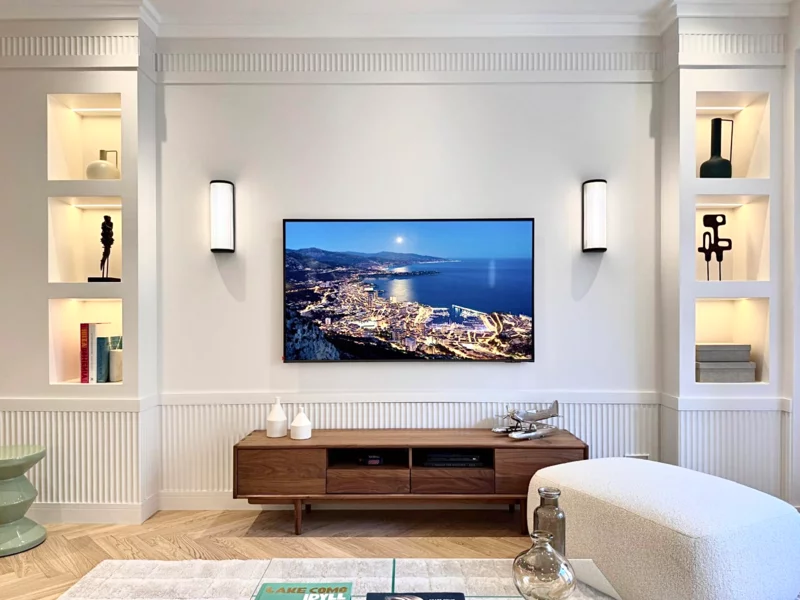
A listing photograph altered by artificial intelligence remains legitimate as long as it shows the property as it is; it becomes misleading the moment it adds something the property does not have.
Discover our selection of apartments
for sale in Monaco
for sale in Monaco
Studios, one- to five-bedroom apartments, penthouses and prestigious properties
The scene has become familiar. On screen, an apartment bathed in light: pale oak floors, a kitchen of clean contemporary lines and, framed in the window, the deep blue of the Mediterranean. At the viewing, the floor belongs to another era, the kitchen is still waiting for its renovation, and the window looks straight onto the façade of the building next door. Nobody has lied, strictly speaking. Each image has simply been “enhanced”.
For decades, property photography rested on a tacit pact: the photographer could flatter a property, but could not invent it. Generative AI broke that pact in the space of a few seasons. It no longer corrects the image of an apartment. It produces the image of an apartment that does not exist.
Public debate tends to reduce the matter to one of labelling: should retouched images be flagged? The question is legitimate, and the law is beginning to answer it. Yet it obscures something deeper. When any photograph may have been fabricated, it is not only the fake images that lose their value; it is all of them. Trust does not disappear. It moves, from the image to the person who puts their name to it.
It is this migration of trust that we set out to describe, from Monaco, where it plays out with particular intensity: how the photograph became a document of proof, how artificial intelligence is devaluing it, what the law says about it in 2026, and what this changes for those who buy and sell in the Principality.
Key Takeaways: AI photos in real estate listings
Artificial intelligence no longer merely improves listing photos: it can invent furniture, finishes, volumes and views. Its most profound consequence is not aesthetic but economic: it strips the image of its value as proof.
- Retouching that renders what the eye perceives on site (light, colour balance, perspective) remains legitimate; an alteration that gives the property something it does not have amounts to deception.
- Generative AI breaks the historic pact of property photography: the image no longer guarantees that what it shows actually exists.
- When buyers can no longer tell the real from the fabricated, they discount every image, honest ones included: this is the mechanism the economist George Akerlof described in 1970.
- An AI-generated image remains acceptable on two conditions: it is flagged as such, and it appears in a listing that also shows real photographs of the property.
- In France, Monaco's neighbour, the government pointed out on 14 July 2026 that the law on misleading commercial practices already applies to listings embellished to the point of distorting essential information.
- Since 2 August 2026, the European Union's regulation on artificial intelligence has required manipulated images that could pass for authentic to be flagged.
- In Monaco, where a large share of buyers shortlist properties remotely, the photograph is the first filter in the decision to buy.
- When the image no longer proves anything, trust shifts to the professional who publishes it and answers for it at the viewing.
Petrini tip: before booking your trip, ask for a live video viewing with the agent on site. It is the hardest proof to fake.
Property photography has never been neutral
Property photography has always flattered its subject, but it was held in check by a physical limit: it could only show what stood in front of the lens.
A wide-angle lens lends breadth to a narrow room. Exposure opens up the shadows of a corridor. The photographer chooses the hour when the light flatters the façade, the moment when the sea is at its bluest. Before viewings, home staging tidies, declutters and sets the scene. Each of these gestures is a form of persuasion, and the market has long accepted them because buyers know the conventions. A room shot on a wide-angle lens looks larger, everyone knows it, and the eye corrects itself the moment it crosses the threshold.
Embellishment was therefore a matter of interpretation, never of invention. The French government made the point itself in July 2026: in its view, AI enhancements are not fundamentally different from the techniques long used to make a property attractive. The argument holds as to intent, which is still to seduce. It holds far less well as to the nature of what is produced.
For what artificial intelligence introduces is not a further degree of embellishment. It is a change in kind.
What AI breaks: the link between the image and the property
Generative AI no longer corrects the shot; it fabricates a plausible image of a property that does not exist, and it is this severing of the link between image and object that is the problem.
In a matter of seconds, these tools furnish an empty room, turn old tiling into contemporary parquet, modernise a bathroom, swap a leaden sky for summer blue, visually widen a living room or clear a view that the building opposite blocks. The result is often remarkable. Above all, it is indistinguishable from a photograph, and therein lies the danger: crude retouching shows, whereas a successful generation no longer does.
The distinction fits in a single sentence. Retouching acts on how the property is seen; generation acts on what is seen. Correcting exposure or straightening a perspective gives the image back what visitors will perceive as they walk in. Altering the materials, the condition of the finishes, the apparent floor area, the view or the surroundings touches the essential characteristics of the property, the very ones on which its price rests. That is no longer presenting an apartment. It is selling a different one.
Retouching or deception: the Petrini framework
Framework drawn up by Petrini Exclusive Real Estate Monaco on the basis of its professional practice. It does not constitute a legal classification.
| Edit to the photo | What it changes | Petrini's position |
|---|---|---|
| Exposure, light, colour balance | Renders what the eye perceives on site | Practised: this is the photographer's craft |
| Perspective correction | Corrects lens distortion | Practised |
| Choice of time of day and light for the shoot | Shows the property at its genuine best | Practised, with a professional photographer |
| Virtual staging of an empty room | Adds furniture that does not exist | Accepted, flagged as an AI image, with the real photograph of the room in the same listing |
| Renovation projection: materials, finishes | Shows a possible state of the property, not its current one | Accepted as a flagged projection, never in place of the real photograph |
| Enlarged volumes, expanded floor area | Distorts the perception of size | Never: this is no longer a projection but a falsification |
| Altered view, sky, sea or surroundings | Distorts the feature that weighs most heavily on price | Never: this is no longer a projection but a falsification |
Table by Petrini Exclusive Real Estate Monaco.
This framework makes it possible to judge a single image. It says nothing about what the proliferation of such images does to the market as a whole. To understand that, a detour through economics is needed.
The market for lemons: when every image becomes suspect
When buyers can no longer tell a faithful photograph from a fabricated image, they stop trusting photographs altogether, and it is honest sellers who pay the price.
In 1970 the economist George Akerlof published a paper that has since become a classic, “The Market for Lemons”, which would earn him the Nobel prize in economics in 2001. In it he describes the market for used cars. A buyer unable to tell a sound car from a “lemon” with a hidden defect offers an average price. Owners of good cars, underpaid, withdraw, and the quality of the market deteriorates. Information asymmetry does not merely penalise the cheats: it penalises, first and foremost, those who do not cheat.
Property photography fits this pattern precisely. Faced with a superb image, the discerning buyer now applies a mental discount: no longer sure whether the light, the parquet or the view is real, they assume it may well not be. The apartment with a genuinely exceptional view falls under the same suspicion as the one whose view was fabricated.
The American legal scholars Robert Chesney and Danielle Citron gave this second effect a name in their work on doctored content: the “liar's dividend”. Once fakes become credible, the genuine article can be called into question. Applied to property, the idea has a very concrete consequence: a truly spectacular view suddenly looks too good to be true. Every misleading listing thus draws down the credibility of all the others.
This mechanism operates in every market. In Monaco it operates with particular force, because the photograph plays a role there that is seldom fully appreciated.
In Monaco, the photograph is the first document in the decision
In Monaco, the listing photograph carries more weight than elsewhere because a large share of buyers shortlist properties from abroad and travel only for those the images have already sold them on.
Many of our clients live outside the Principality, in London, New York, Dubai, Milan or Geneva. They run companies, keep demanding diaries and plan their visits around a handful of carefully chosen viewings. The listing is not one first impression among many: it is the filter that decides whether they make the trip. The pace of the buying cycle in Monaco, which can accelerate very quickly once a buyer is convinced, makes this remote shortlisting all the more decisive. When the property found on site no longer resembles the one on screen, the loss is not measured in aesthetic disappointment, but in a journey, a day and a measure of trust.
We saw this with a client who travelled from abroad for an apartment that its photographs presented as fully renovated, and which in reality still needed renovating. His disappointment with that property was not the most damaging consequence. The most damaging was what followed: from that viewing on, he approached every listing with suspicion. The liar's dividend mentioned above is no abstraction.
The view concentrates the risk. In the Principality, a sea view is not one amenity among others: it accounts for a considerable share of an apartment's value, and is judged floor by floor, according to orientation and the surrounding buildings. That is why our guide to sea-view apartments in Monaco dwells on what might, one day, obscure the horizon. An embellished or invented view does not mislead on a detail: it misleads on price.
Reputation completes the shift. Monaco is a small territory where professionals, notaries, private bankers and family offices all know one another. A misleading listing does not disappoint a single buyer; it gets talked about, and clings lastingly to the name of whoever published it.
The seller, finally, pays the price at the negotiating table. Depending on their profile, disappointed buyers react in one of two ways. The most demanding cut the viewing short and do not come back: they were not looking for a bargain, but for a counterpart they could rely on. The most seasoned negotiators stay, and turn every gap between image and reality into an argument for revising their offer.
That is why we advise every owner who wishes to sell their apartment in Monaco to favour faithful photographs over spectacular ones. A property may be shown at its best; it should never be reinvented.
A price grounded in a realistic valuation of the property and in honest images holds firm all the way to signature; a price grounded in an illusion crumbles with every viewing.
Faced with these excesses, lawmakers have begun to respond. Their response is necessary. It is not sufficient.
The law in 2026: a duty to label, not a guarantee of truth
In 2026 the law penalises misleading listings and requires manipulated images to be flagged, but a label tells buyers that an image has been altered without telling them what the property actually looks like.
In France, Monaco's immediate neighbour, a member of parliament put the question to the government in March 2026, and the ministerial answer published on 14 July 2026 offers a clear reading. No legislation specifically targets property photographs generated by artificial intelligence, but the French Consumer Code already makes it possible to penalise a listing whose embellishment distorts essential information and sways the buyer's decision. The answer also notes that a buyer who has been the victim of fraudulent misrepresentation may go to the civil courts to have the sale annulled or the price reduced.
The European Union's regulation on artificial intelligence, the most advanced legislation in the world on the subject, adds a transparency obligation. Since 2 August 2026, anyone who publishes a manipulated image liable to pass for authentic must disclose that it has been artificially generated or altered. For tools already on the market at that date, invisible, machine-readable marking becomes mandatory from 2 December 2026.
These rules deal with transparency. They do not deal with information. A buyer confronted with ten images bearing the words “retouched with AI” now knows one thing for certain: they do not know what the apartment looks like. Labelling guards against the lie; it does not restore the truth.
Monaco is not a member of the European Union, and the precise reach of these texts for a Monegasque listing viewed from Europe is a matter for lawyers to analyse. Our approach does not depend on it: we did not wait for a legal obligation before refusing to show a property that does not exist.
If neither the image nor the label can any longer establish what a property really is, trust must find another footing.
Trust is moving from the image to the person who signs it
We are sometimes told that one must move with the times, and that virtual staging helps buyers picture themselves in an empty space. We do not dispute it, and we use it ourselves. A furnishing or renovation projection has its place in a listing, on two conditions we do not negotiate: that it be flagged as an image produced by artificial intelligence, and that the real photographs of the property appear in the same listing. The buyer sees what is possible, but sees what is real first.
Yet as the image loses its value as proof, it is the professional who publishes it who becomes the guarantee. An estate agent is mandated to represent a property, and that representation commits their word to the buyer as much as to the seller. Flatter, yes: the right light, the right hour, the right framing, a professional photographer. Invent, no. The line comes down to a question we ask ourselves before every publication: will the person who opens the door find what they saw?
The evidence that withstands artificial intelligence
When it comes to a listing, the only evidence that withstands artificial intelligence is the kind that commits someone: the dimensioned floor plan, the continuous video, the live remote viewing and the answer of a professional who stands behind what they publish.
On screen, several clues should raise suspicion: straight lines that ripple slightly, reflections with no coherent light source, missing shadows beneath furniture, textures that are too smooth or too regular, furniture whose scale does not match the room. A perfectly unobstructed view from a building tucked into the heart of a district also deserves checking.
The decisive test remains documentary. A dimensioned floor plan allows perceived volumes to be checked against actual floor areas. A video shot in a single take, moving from one room to the next, is far harder to fabricate coherently than a still image, even if video editing tools are advancing in their turn. A live video call conducted from inside the apartment leaves very little room for retouching. That leaves the simplest question of all, which should never go unasked: have these images been altered, and how? The answer, and the way it is given, often say as much about the agency as about the property.
If we could give only one piece of advice to a buyer shortlisting from abroad, it would be this: before booking any trip, ask for a live video viewing with the agent on site. It is the hardest proof to fake, and the most revealing: a professional who sidesteps the exercise has already given you an answer.
These precautions protect the buyer. They also sketch, by implication, what an agency must now offer.
The more perfect the images, the less they will be worth
At Petrini Exclusive Real Estate, we entrust our shoots to a professional photographer, we work on light and colour balance, and we use artificial intelligence only in the open: every image it produces is flagged as such, and the real photographs of the property are published alongside it, in the same listing. We are also giving video an ever larger place.
Not because it cannot be faked: tools now exist to alter it too. But a continuous shot, leading from one room to the next and then from the window to the view, forces the image to remain consistent with itself from beginning to end. It conveys volumes, the flow between rooms and the light as they really are, whereas a single photograph can frame anything. Video does not replace the viewing; it offers, from a distance, the most honest foretaste of it.
There is nothing technophobic about this rule. An exceptional property does not need to be invented in order to seduce; it needs to be shown accurately, at the right moment, to the right person. The same logic leads us, for confidential off-market properties, to disclose the address and the interior photographs only at the viewing, and only to a buyer already qualified. Discretion and fidelity of the image serve the same end: a viewing that delivers exactly what the agency promised.
Artificial intelligence will keep improving, and its images will become more convincing still. That is precisely why they will be worth less and less. A photograph will be able to show anything; it will no longer be able to prove anything. Proof will lie in the viewing, and in the word of the person who promised it.
Frequently asked questions about AI photos in real estate
- Can an estate agency use AI for its listing photos?
Yes, provided the image remains faithful to the property or the alteration is clearly flagged. Correcting light or colour is standard retouching. Adding furniture, materials, floor area or a view that do not exist may amount to a misleading commercial practice. - Is virtual staging allowed in a property listing?
Virtual staging is not prohibited as such. It should be flagged as an altered image and, ideally, shown alongside the real photograph of the same room. Since 2 August 2026, the European Union's regulation on artificial intelligence has required manipulated images that could pass for authentic to be flagged. - How can you tell whether a listing photo has been altered with AI?
The most common clues are rippling lines, inconsistent reflections or shadows, overly smooth textures and furniture of doubtful scale. The most reliable test is to ask for the dimensioned floor plan, a video of the main room and a clear answer on what retouching has been done. - What should you do if the property you visit does not match the listing photos?
Raise the discrepancy with the agency before making any offer, and rely on the floor plan and the property's documents rather than on the images. In France, the government pointed out in July 2026 that a buyer who has been the victim of fraudulent misrepresentation can ask the courts to annul the sale or reduce the price. - Which photo edits are acceptable in a property listing?
At Petrini Exclusive Real Estate Monaco, we regard as legitimate the edits that keep the image faithful: exposure, light, colour balance and perspective correction. An image produced by artificial intelligence, such as virtual furnishing, remains acceptable if it is flagged and the real photographs appear in the same listing.
Buying and selling in Monaco with confidence
Author

Nos derniers biens disponibles
 Sole agent
3 700 000 €
Sole agent
3 700 000 €
Palais Belvédère · La Rousse - Saint Roman
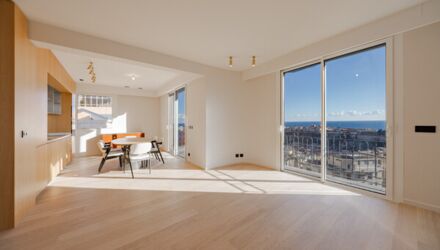
Bright 3-room apartment to renovate on a high floor, a stone's throw from Larvotto
Located on the 8th floor of a building with elevator, the Palais Belvédère is located in the sought-after area of La Rousse - Saint Roman. This 3-room apartment of 63 m² offers high ceilings and a beautiful view. A functional and ideally located apartment, close to the Boulevard d'Italie and the Larvotto. This apartment to refresh offers great potential for renovation to create an interior in its image.
 Sole agent
Price on request
Sole agent
Price on request
Palais du Printemps · Moneghetti
Magnificent renovated penthouse with sea views - Le Palais du Printemps
In the heart of the Moneghetti, discover this duplex penthouse, a perfect fusion between the elegance of a bourgeois building and a contemporary renovation. Climb up its internal staircase and let yourself be surprised by a large roof terrace, equipped with a pergola and a summer kitchen, revealing a breathtaking view of the Mediterranean Sea.
 10 300 000 €
Villa Minerve · Carré d'Or
6 ROOMS - VILLA MINERVE
In the heart of Monte-Carlo, a stone's throw from the Carré d'Or, this superb 6-room apartment of 185 m² under the law 887 offers a breathtaking view of Port Hercule.
Recherches fréquentes
Les derniers articles




Contact our real estate agency in Monaco


In which district would you like to search for your future apartment?